SWPPP Deficiencies That Trigger NOVs on Construction Sites
Missed inspections, failed controls, and outdated plans each trigger separate violations.
Construction-site SWPPP deficiencies trigger NOVs through a recurring pattern of missed inspections, failed controls, outdated plans, authorization gaps, and incomplete records. Most are execution failures. The practical defense is to treat field performance, permit coverage, and documentation as separate obligations, then test all three through a standing pre-inspection audit.
Why SWPPP violations keep happening on sites that know the rules
Inspectors compare what the SWPPP says with what is on the ground and what the records show. They are not assessing whether the contractor understands stormwater rules or intended to comply. Controls that work do not excuse missing inspection records, and complete records do not excuse controls that fail. The execution gap lies between these obligations, where a team satisfies one and assumes it has satisfied the others.
Land disturbance of one acre or more triggers NPDES permit coverage, including smaller sites within a larger common plan of development that reaches that threshold. The obligation begins before earth disturbance.
How inspectors trigger and escalate enforcement — including the vectors site teams don't anticipate
Routine regulatory inspections are only one route to enforcement. Public complaints about visible offsite turbidity can bring attention to a site outside an expected inspection cycle. Aerial or satellite monitoring can identify unpermitted land disturbance, while discrepancies identified after an NOI is filed can prompt scrutiny of permit coverage. None of these routes depends on the site team receiving time to prepare.
Iowa DNR can issue NOVs, assess fines, and require corrective action plans. Colorado CDPHE and other state programs have their own penalty schedules, and sites also face penalties under the federal Clean Water Act. A site’s compliance risk is therefore not confined to the inspection practices of one agency.
The penalty structure further separates each deficiency from the overall condition of the project. Clean Water Act penalties apply on a per-day, per-violation basis, so several concurrent deficiencies can create multiple independently enforceable violations. An inspection that finds a failed control, a missing inspection record, and an outdated plan does not reveal just one stormwater problem. It exposes the separate obligations that make the following deficiency categories consequential.
Missed and undocumented inspections — the violation that requires no physical failure at all
A physically clean site can still receive an NOV for incomplete or missing inspection logs. The inspection record is itself a permit deliverable. Missing a required inspection is a direct violation even when no discharge occurred during the gap. Conducting an inspection without documenting it leaves the separate recordkeeping obligation unmet.
Construction stormwater permits often call for weekly or biweekly inspections, but each site must follow the schedule in its permit. TCEQ’s TPDES Construction General Permit TXR150000 requires inspections at least once every 14 calendar days and within 24 hours of the end of a storm event of 0.5 inches or greater. The rainfall measurement triggers that storm inspection requirement even when the team observed no discharge. A routine inspection schedule cannot substitute for a required rain-event inspection.
A BMP may have performed throughout a storm, yet the required inspection and its record remain due. Conversely, a completed log cannot establish compliance with maintenance requirements when the control has failed. Each obligation needs its own evidence, and neither cancels the other.
BMP maintenance failures — why presence on the site plan is not the same as functioning in the field
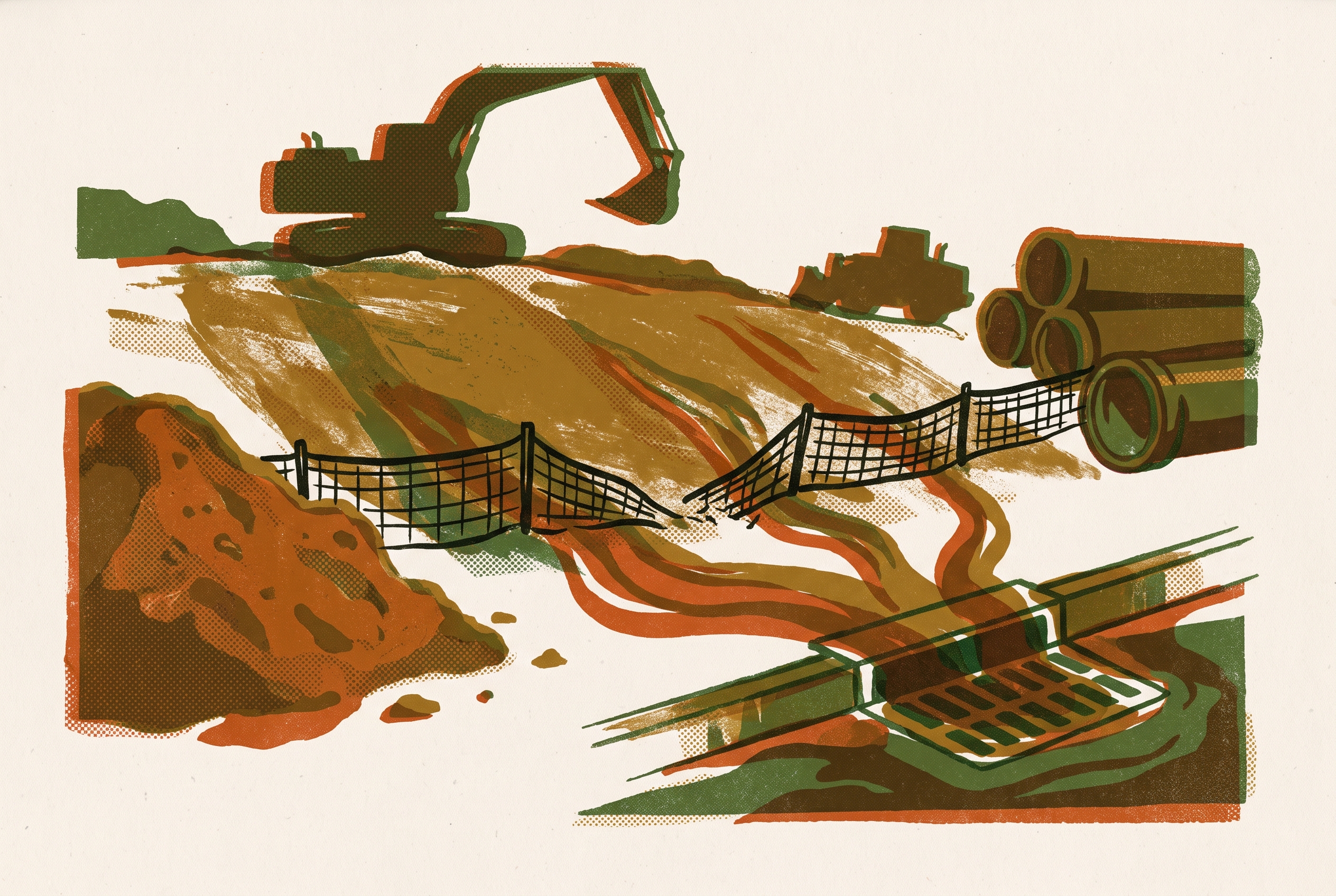
Failed or degraded BMPs are a recurring finding in construction stormwater enforcement because installation is only the beginning of the obligation. The CGP standard requires controls to be properly installed, maintained, and functioning. A silt fence undermined or bypassed after a significant storm remains visible, but sediment-laden runoff can escape around or under it without filtration. Its presence provides no protection against a finding that it no longer works.
Controls are often neglected after they are installed. Wind, rain, and truck traffic degrade controls, while gaps in formal checking leave that deterioration unrecorded. Selection also matters because maintenance cannot resolve every mismatch between a control and its setting. In a high-desert area, sustained wind can move as much sediment as rain, so controls specified for humid conditions may fail in high-desert conditions.
Repair deadlines create a further obligation once a failure is identified. Pennsylvania’s PAG-02 requires repair completion within 24 hours when a BMP failure has resulted in or is likely to result in pollutants flowing off the project site, while lower-risk failures have a longer completion window. Deadlines vary by permit and severity, so a universal repair rule is not a sound compliance assumption. Delayed correction adds exposure to the original failure, but even prompt repairs leave another question unresolved if the SWPPP no longer describes the controls in the field.
SWPPP not updated when the site changes — the plan-to-field mismatch that creates paper violations
A SWPPP is a working representation of the site. Grading changes, new staging areas, changes in contractors, and revised limits of disturbance require amendments. These changes often go unrecorded as teams try to stay on schedule. The resulting mismatch creates a compliance problem even when inspection logs are current and the installed controls function.
A substitution makes the distinction clear. If the SWPPP specifies silt fence but the crew installs wattles, the plan does not describe the field condition. Technical equivalence, or even better performance, does not remove the need to record the change. Similarly, BMP selection must reflect slope, soil type, drainage area, site phase, and proximity to inlets or receiving waters. A plan that works for grading may no longer work for the next phase.
Washoe County stormwater guidance places implementation within a broader process that includes planning, site assessment, BMP selection, and evaluation. Its rules for carrying out the plan include maintenance, inspections on schedule, and amendments as the work changes. Iowa law likewise requires amendments when changes at the site significantly affect the chance that pollutants will be discharged, with an update within seven calendar days for a reportable release or noncompliance.
Pre-authorization discharge and late NOI filing — violations that occur before a shovel hits the ground
The site must have permit coverage before earth-disturbing activity begins. A completed SWPPP without confirmed NOI authorization is a plan with no permit behind it. Even after filing the NOI, the team must meet the required lead time and wait for written authorization before starting grading. Later authorization cannot retroactively erase the period of unpermitted activity or a discharge that occurred during it.
Pennsylvania’s PAG-02 became effective December 8, 2024, and runs through December 7, 2029. Existing projects had to submit a Renewal NOI by December 7, 2024, to maintain coverage under the reissued permit. Projects that missed renewal lost coverage and had to stop work until new coverage was obtained.
The practical failure is treating an authorization deadline as paperwork that can follow the work, even though authorization must be in place before work proceeds. The SWPPP explains how permit conditions will be met, while authorization establishes whether the project has coverage to proceed. Both must be in place, and neither substitutes for the other.
Failure to stabilize — the most enforcement-cited physical condition in several states
Final stabilization, typically substantial vegetative cover or equivalent permanent stabilization, must be achieved before permit closeout. Erosion controls must be kept in working order until that standard is met.
EPA’s proposed 2027 Construction General Permit signals more explicit requirements for stabilization timing. It would require sediment basin stabilization measures before stormwater is first directed to the basin.
The same proposal would replace the narrative limitation requiring discharges to be “controlled as necessary to meet applicable water quality standards” with more specific narrative limits. For now, however, the site must meet the stabilization standard and timing in its current permit. Project completion alone does not meet it.
Generic plans and documentation gaps — the deficiency that multiplies every other penalty
A generic SWPPP can reveal its inadequacy as soon as an inspector compares it with the site. A source inventory that leaves out staging areas, concrete washout locations, chemical storage, or waste materials fails to show what is on the site. Each omission can be separately citable. The document fails to account for pollution sources the plan must address.
Missing inspection logs, training records, and corrective-action notes put the site at risk of further penalties. Those documentation failures are distinct from the physical deficiencies they concern and can accrue on a per-day basis. A repaired BMP does not, by itself, resolve a missing corrective-action record. Multiple omissions can compound the exposure from substantive findings, and repeat findings can escalate to stop-work orders.
EPA’s proposed 2027 CGP would have site information shared electronically to help with compliance and with answering questions from the public. The Federal Register notice explains that EPA’s lack of real-time access to SWPPP information can delay those functions. The proposed permit also states that EPA would not review or approve that version of the SWPPP or use it to make definitive compliance determinations.
Structured digital and AI-assisted workflows are useful here to the extent that they close a specific documentation gap. Digital inspection tools can include location-based proximity locks, dynamic permit-specific filtering, and auto-generated corrective action records. Those functions address the distance between an inspection in the field and a completed, submitted record.
How to use the deficiency pattern as a pre-inspection audit
Start with inspection log currency. Confirm that every required inspection is complete, including rain-event inspections within the applicable 24-hour window, and that entries are detailed and site-specific. Then check BMP condition against intended performance. Verify that corrective actions are documented and finished within the required deadlines, and replace degraded controls before the next storm.
Next, compare the SWPPP with current grading limits, staging areas, contractors, and installed BMP types. Record substitutions even when the controls chosen in the field work as they should, so the plan reflects what is there. Then confirm that written authorization is in hand, the permit version is current, and renewal deadlines are tracked. This sequence tests both whether the work matches the plan and whether the project has coverage to perform it.
Review stabilization separately from construction progress. Check inactive areas and areas near surface water against applicable stabilization windows, and document the final stabilization timeline for closeout. Complete the audit by checking that postings are current and legible, training records are on-site, the source inventory is complete, and the corrective-action log is current. These checks target the independently citable gaps that a general assessment of site cleanliness can miss.
Build this sequence into standing project management workflows. Firms that stay off the NOV list treat SWPPP compliance as a continuous operational discipline.
Sources
- Common SWPPP Violations That Could Shut Down Your Project - CRG Texas Environmental Services
Provided grounding for recurring BMP maintenance failures, generic plan deficiencies, and the pattern of execution gaps between knowing the rules and field performance.
- Handling a Stormwater Notice of Violation
Informed the discussion of how NOVs are issued, penalty structures, corrective action plan requirements, and the per-day per-violation basis of Clean Water Act penalties.